Pearland Metal Digest is a local resource covering metal gates in Pearland, TX. The guides below explain materials, typical costs, local considerations, and how the work is usually done.
A driveway gate that opens on command but refuses to finish closing is one of the most common problems a Pearland homeowner runs into, and the cause is almost never a single dramatic failure. A gate is a moving assembly of metal, mechanical bearings, and electronics that all have to agree before the panel completes its travel. When one part objects, the safest thing the system can do is stop where it is. Learning which part is objecting saves you from replacing the wrong thing and paying for a repair the gate never needed.
The safety system is built to stop a close
Automated gates are designed around the assumption that a person or vehicle could be standing in the opening, so the closing cycle is the most heavily guarded part of the whole operation. The device doing that guarding is usually a photoelectric sensor, a pair of units mounted low on the posts that send an infrared beam across the driveway. A photoelectric sensor determines the presence or absence of an object using a light transmitter and a photoelectric receiver, and the common driveway arrangement is the opposed, or through-beam, type where one post transmits and the other receives. If anything breaks that beam, a stray branch, a parked trash bin, or a spider web heavy with Gulf Coast morning dew, the controller assumes the path is blocked and cancels the close.
Because these sensors face each other across an outdoor gap, they fall out of alignment easily. Clay soil around Pearland swells when it rains and shrinks through the dry stretches of summer, and that seasonal movement can tilt a gate post by a degree or two. That is all it takes to send the beam slightly past its target and leave the gate convinced something is always in the way. A lens fogged by humidity or filmed with pollen has the same effect as a solid object. Before assuming the motor has failed, check whether the two sensor eyes are clean, level, and pointed straight at each other. A great many no-close complaints end right there.
When the gate itself has moved
The second large category is physical, and it usually traces back to the hinge. A hinge is a mechanical bearing that connects two solid objects and allows rotation about a fixed axis, and on a swing gate it carries the entire weight of the panel through a single line of pivots. A wrought iron or steel gate is heavy, and over years that load slowly wears the hinge pins and elongates the holes they ride in. The result is sag. The leading edge of the gate drops a fraction of an inch, and instead of gliding to the latch it drags on the driveway or catches on the receiver post. The motor senses the resistance, reads it as an obstruction, and reverses.
Corrosion accelerates the same failure. Corrosion is the natural process that converts a refined metal back into a more chemically stable oxide, and on a gate the visible result is rust, an iron oxide formed when iron reacts with oxygen in the presence of water or air moisture. Pearland sits on the Gulf Coast, where high humidity and the faint salt carried inland give hinge pins a hard life. A pin that is rusting is also seizing, and a stiff hinge forces the motor to work harder on every cycle until it starts giving up partway through the close. A related trap is galvanic corrosion, the electrochemical process where one metal corrodes preferentially when it is in electrical contact with a different metal in the presence of an electrolyte. A steel gate hung on hardware of a dissimilar metal, with humid air acting as the electrolyte, can degrade at the joint faster than either metal would alone. If a hinge is dry, ground down, or frozen with rust, cleaning and lubricating it, or replacing the pin, often restores a clean close. If you are unsure whether the panel has actually dropped, the fix chosen by a local gate technician for usually starts with checking the hinge line and the gap at the latch before anything electronic is touched.
The latch and the strike
A gate can also fail to register as closed even when it swings all the way. The latch is a mechanical fastener that engages a keeper or strike on the opposite post, and if the panel has shifted, the latch tongue can land above or below the strike and never seat. Owners often read this as the gate not closing when the real issue is that the two halves no longer line up. Re-shimming the strike or adjusting the gate stop brings them back into register.
Electric and control faults
If the beam is clear and the gate moves freely by hand, the problem is more likely in the drive or the controller. The electric motor converts electrical energy into mechanical energy through the interaction of a magnetic field and current in a winding, and a motor that is failing often has enough torque to start a cycle but not enough to finish it, which shows up as a gate that opens fully yet stalls before latching. Worn drive gears, a slipping chain, or a stripped nylon nut on a linear operator produce the same partial travel.
Just as common is a limit setting drift. The operator learns how far to travel in each direction using limit switches or an encoder, and if a close limit is set short, the panel stops before the latch. If it is set long, the gate hits the post hard, the controller reads the impact as an obstruction, and it reverses on principle. Gulf Coast storms play a quiet role here too. A power flicker during one of the region's frequent thunderstorms can scramble stored limits or reset an opener to defaults, and a gate that closed perfectly yesterday suddenly refuses today. Reprogramming the limits, or restoring power cleanly after an outage, resolves a surprising share of sudden-onset cases.
Battery-backed and solar operators add another failure point. A worn backup battery may hold enough charge to open a light gate but sag under the higher current draw of the close, especially on a cold morning. The gate opens, then dies mid-close because the voltage collapses under load. Testing the battery under load rather than at rest is the way to catch this.
A gate that has stopped closing on a Creekside driveway is usually diagnosed in the wrong order, with the operator replaced before anyone has checked the beam alignment or the ground clearance under the leaf. Sequencing that check, and knowing which step is a repair call and which is a five minute job, runs through the troubleshooting guides on pearland metal gates notes.
How to narrow it down before calling anyone
A short, safe sequence separates most causes without tools. Watch a full cycle and note exactly where the gate stops. If it reverses the instant it starts closing, suspect the photoelectric sensor or a control fault. If it travels most of the way and then stops or reverses near the post, suspect sag, a dragging edge, or a close limit. With the operator disengaged using its manual release, push the gate through its arc by hand. Smooth and quiet points to an electrical or sensor issue. Grinding, catching, or a hard drop points to hinges, corrosion, or alignment.
Clean and realign the two beam sensors, and clear anything in the opening.
Check the hinge line for sag, rust, and stiffness, and confirm the latch meets its strike.
Disengage the operator and move the gate by hand to feel for binding.
Note whether the trouble began after a storm or power loss, which points at limits or the battery.
None of this changes the underlying reality of owning a metal gate on the Gulf Coast, which is that humidity, clay movement, and the occasional storm will keep testing every joint and sensor on the assembly. A gate that stops closing is rarely broken beyond help. It is usually telling you, in the only language it has, that one specific part has drifted out of the narrow tolerance the whole system depends on. Reading that message correctly is most of the repair.
Ask what a metal gate repair costs around Pearland and the honest answer is that the number depends far more on what is wrong than on the gate itself. Two gates that look identical from the street can carry very different repair bills, because one needs a cosmetic touch-up and the other needs a structural weld and a new operator. Rather than quote figures that would not survive contact with your actual gate, it is more useful to understand the cost drivers, because once you know which category your problem falls into, the range becomes predictable and you can tell a fair estimate from an inflated one.
Material sets the baseline
The metal your gate is made from shapes almost every repair decision that follows. Wrought iron is an iron alloy with a very low carbon content, historically worked by heating and hammering rather than casting, and it is prized for ornamental gates because it can be shaped into scrollwork. Its low carbon content also makes it relatively soft and forgiving to repair, though genuine wrought iron is uncommon in newer gates. Most gates sold as iron today are actually steel, an alloy of iron and carbon with better yield and fracture strength at low material cost. Steel repairs are straightforward and inexpensive to source, which keeps their cost down.
Cast iron is a different story. Cast iron is an iron-carbon alloy with a carbon content above two percent, and white cast iron in particular is very hard but brittle, allowing cracks to pass straight through rather than deflecting them. A cracked cast iron component often cannot be simply welded back together the way steel can, so the repair may mean fabricating or replacing the part, which costs more. At the other end, aluminium has a density about one-third that of steel and forms a protective oxide layer that resists corrosion, so aluminium gates rarely rust, but the light sections dent and bend more easily and specialized welding raises the labor rate. Stainless steel, an iron alloy carrying at least ten and a half percent chromium that forms a self-healing passive film, resists corrosion best of all but carries the highest material and fabrication cost when a section must be replaced.
Structural repairs: welding and fabrication
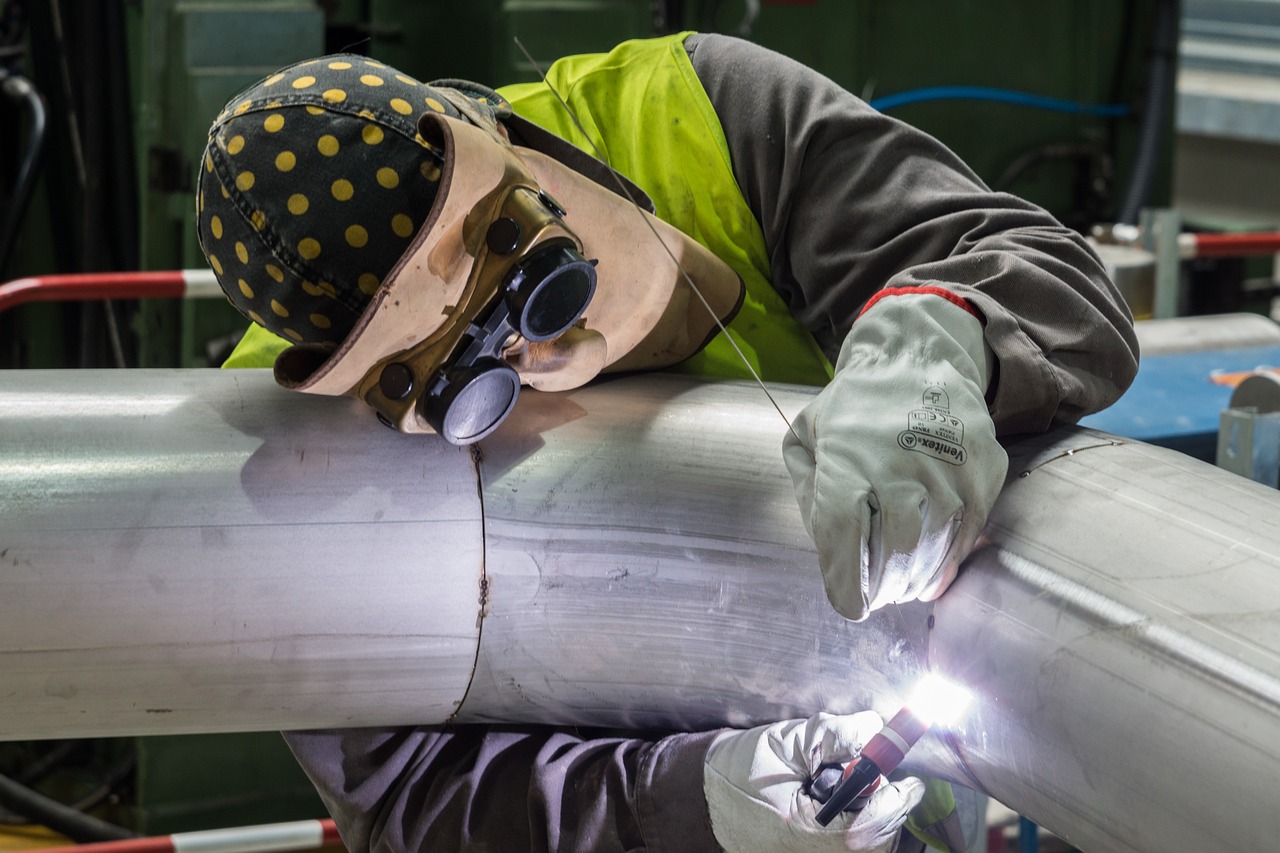
The costliest category is structural, meaning the frame itself has cracked, bent, or torn at a joint. This is repaired with welding, a fabrication process that joins metals by using high temperatures to melt the parts together and let them cool into a fused joint. The common method for gate steel is gas metal arc welding, where an electric arc forms between a consumable wire electrode and the workpiece and a shielding gas protects the weld from atmospheric contamination. A single clean weld on an accessible steel joint is a modest job. A gate that has been hit by a vehicle, twisted by a fallen limb during a storm, or torn loose at several points becomes a fabrication project, and fabrication, the creation of metal structures by cutting, bending, and assembling, is billed by time and complexity rather than by the part. Ornamental gates with forged scrollwork raise the price further, because forging shapes metal with localized compressive force and matching an existing decorative pattern takes skilled handwork rather than an off-the-shelf piece.
Hinges, latches, and alignment
Between cosmetic and structural sits a broad middle band of mechanical repairs, and these are where most Pearland gate bills actually land. A worn or rusted hinge, a mechanical bearing that carries the panel weight through its pivot, is a common replacement. A latch that no longer seats against its strike, a sagging panel that drags, or a post that has shifted because the clay soil swelled and settled under it are all realignment jobs. For a fair estimate on , the single biggest variable in this middle band is whether the post itself has moved, because resetting a leaning post in Pearland clay is a different scope from simply swapping a hinge pin. Labor dominates these repairs, so access, gate weight, and how many points need adjusting matter more than any single part.
Finish and corrosion work
On the Gulf Coast, a large share of repairs are really corrosion repairs. Corrosion is the gradual conversion of refined metal back into a more stable oxide, and on iron and steel it appears as rust. Pearland humidity keeps moisture on the metal for long stretches, and the salt that drifts inland from the coast speeds the reaction, which is why the same gate rusts faster here than it would in a dry climate. Corrosion work runs a wide range. Surface rust caught early may need only sanding and recoating. Rust that has eaten through a rail means cutting out and replacing metal before any finish goes on, which pushes the job toward the structural tier.
The finish you rebuild to also affects the cost. Powder coating is applied as a dry powder, charged electrostatically and then cured under heat into a thick, tough film that is more durable than conventional liquid paint, and refinishing a full gate this way requires stripping, blasting, and oven curing, so it costs more up front than a brush repaint but lasts far longer in the humid air. Galvanization, applying a protective zinc coating usually by hot-dip immersion in molten zinc, is often done underneath as sacrificial protection, and re-galvanizing a whole gate is a specialty service priced accordingly. On aluminium, anodizing thickens the natural oxide layer through an electrolytic passivation process, which is again a shop treatment rather than a field repair. The general rule is simple: field touch-ups are cheap, shop refinishing is not, and the value of shop refinishing is that it postpones the next repair.
Automation and electronics
If the gate is automated, a second cost universe opens up. The electric motor that converts electrical energy into the mechanical force to move the panel is the single most expensive component to replace, and a failed operator can approach the cost of the metalwork itself. Below that sit the control board, the limit and encoder assemblies, and the accessories: the keypad for code entry, the photoelectric sensor beams that guard the closing path, and the remote or receiver. Storm-related electrical damage is common in the region, because a power surge during a thunderstorm can take out a control board while leaving the gate itself untouched. These parts vary widely in price, so an automation repair estimate should always itemize which component failed rather than quote a lump sum.
Repair bills in Silvercreek cluster around the same few items year after year, with hinge and roller work at the low end and reframing or recoating at the top. Seeing where a given quote sits on that range before agreeing to it is why the cost and fabrication notes on pearland metal gates notes are kept beside each other.
How to read an estimate
Because the range is so wide, the useful skill is sorting your own problem into a tier before the estimate arrives.
Cosmetic: surface rust, a scratch, a loose finial. Lowest cost, mostly a finish and small-parts job.
Mechanical: hinge, latch, alignment, sag, a shifted post. Moderate cost, driven by labor and gate weight.
Structural: cracked frame, torn joint, impact damage. Higher cost, driven by welding and fabrication time.
Electronic: a failed motor, board, sensor, or keypad. Ranges from a cheap accessory swap to a major operator replacement.
A trustworthy estimate names the tier, itemizes parts against labor, and accounts for the Gulf Coast reality that a repair which ignores corrosion or a moving clay-soil post will simply come back. The cheapest quote is not always the real one, because a weld that skips rust remediation or a hinge swap that ignores a leaning post is a repair you will pay for twice.
Choosing a driveway gate for a Pearland home is less about picking a style you like from a catalog and more about matching a set of engineering decisions to a specific piece of Gulf Coast ground. The same gate that thrives in a dry inland climate can struggle here, where humidity, clay soil, and the occasional serious storm test every choice. A gate is simply a controlled point of entry to an enclosed space, but the version that will still open smoothly and look good in ten years is the one whose material, motion, finish, and automation were chosen with the local conditions in mind. Working through those four decisions in order keeps the project from becoming a series of expensive corrections later.
Swing or slide: start with the ground
The first decision is how the gate moves, and your driveway usually decides it for you. A swing gate pivots on hinges and needs a clear arc to open into, so it suits a flat, level entrance with room behind the gate line. The catch in Pearland is grade and soil. If the driveway rises toward the house, a swing gate can bind against the slope, and if the ground heaves as the clay soil swells and shrinks with the seasons, the swing arc can start to drag. A sliding gate travels sideways along a track or, in the cantilever style, hangs on rollers and spans the opening without touching the ground, which sidesteps both the slope problem and the standing water that collects during heavy rain. Sliding gates need clear length along the fence line to park in, so a narrow lot may rule them out. Width matters too: a very wide opening often favors a slide or a dual-swing pair over a single long panel that would sag under its own weight.
Material: the decision the climate cares about most
Once motion is settled, material is where the Gulf Coast environment exerts the most pressure, because corrosion, the gradual conversion of refined metal back into a more stable oxide, never stops working on an outdoor gate here. The humid air keeps moisture on the metal and the faint coastal salt speeds the reaction, so the material you choose is really a choice about how you will manage rust for the life of the gate.
Iron and steel
Wrought iron is the classic ornamental choice, an iron alloy with a very low carbon content that can be shaped into the scrollwork many Pearland buyers want. True wrought iron is now rare, and most gates sold as iron are steel, an alloy of iron and carbon that offers high strength at low cost and welds easily for custom designs. Both are strong and repairable, but both are iron-based, which means they will form rust, an iron oxide, wherever the protective finish is breached. Choosing steel is choosing strength and value while accepting that the finish is doing the real anti-corrosion work. Cast iron, with its carbon content above two percent, is harder but brittle and is generally used for decorative castings rather than the working frame.
Aluminium and stainless steel
Aluminium takes the opposite approach to corrosion. With a density about one-third that of steel and a strong affinity for oxygen that forms a protective oxide layer on contact with air, aluminium resists rust naturally and stays light enough to be easy on an automated operator. It is less rigid than steel, so wide spans need heavier sections, but for a humidity-prone climate it removes the constant rust battle. Stainless steel goes further still: its chromium content of at least ten and a half percent forms a passive film that protects the surface and can self-heal when exposed to oxygen, making it the most corrosion-resistant common choice, though also the most expensive. A related option some owners like for its look is weathering steel, a group of alloys that form a stable external rust layer which eliminates the need for painting, though the running rust it sheds early on is worth understanding before you commit.
Finish: the coating does the protecting
Whatever metal you pick, the finish is what stands between it and the Pearland air. On steel, the strongest combination starts underneath with galvanization, a protective zinc coating usually applied by hot-dip immersion in molten zinc, where the zinc corrodes sacrificially in place of the steel. Over that, powder coating gives the visible, durable surface. Applied as a dry powder that is charged electrostatically and then cured under heat, powder coating forms a thick, tough film that outlasts conventional liquid paint and holds up far better than a brushed finish in high humidity. For aluminium, anodizing thickens the natural oxide layer through an electrolytic passivation process, hardening the surface without adding a coating that can chip. The lesson is that the finish is not cosmetic here. It is the primary defense, and a gate specified with galvanizing under powder coat will simply last longer than the same gate with paint over bare steel. If you want to weigh full quotes for against each other fairly, ask each one to state the exact finish stack, because that single line separates a gate that ages gracefully from one that streaks with rust in a couple of humid summers.
Automation and access
Most Pearland driveway gates are automated, and the options have grown well beyond a simple remote. At the core is an electric motor that converts electrical energy into the mechanical force that swings or slides the panel. Around it you choose how people get in. A keypad lets guests enter a code, a remote keyless system uses an electronic remote to unlock without a mechanical key, and radio-frequency identification tags can open the gate automatically as a resident vehicle approaches. An intercom, a stand-alone voice system that can also trigger a door latch, lets you screen visitors from inside the house, and many can integrate with the gate release directly. Safety is not optional: a photoelectric sensor beam across the opening detects a vehicle or person in the closing path and stops the gate, and it is what keeps an automated gate from closing on something. Plan for power protection as well, since regional thunderstorms make surge protection and a battery backup genuinely useful rather than luxuries.
Buyers in Twin Creek Woods often arrive with the style settled and the site unexamined, which is backwards, because the slope and the setback narrow the gate type long before any material preference does. Site survey, material selection and installation sequence are laid out in that order on pearland metal gates notes.
Rules, wind, and the practical checklist
Two local factors close out the decision. First, many Pearland neighborhoods fall under a homeowner association, a private organization that sets rules for the community, and an HOA may dictate gate height, style, setback, or color, so confirming those limits before you order prevents an expensive redo. A building code, the set of construction standards enforced by the local jurisdiction, may also govern setback from the street and safety features on an automated gate. Second, wind. Wind engineering studies the effects of wind on built structures, and a large solid gate panel behaves like a sail during the strong winds this stretch of the Gulf Coast sees. A design with open pickets rather than a solid infill lets air pass through and puts far less load on the posts, hinges, and operator during a blow. When you weigh all four decisions together, the checklist becomes clear.
Match swing or slide to your grade, soil movement, and available space.
Choose the metal by how you want to manage corrosion, not by looks alone.
Specify the full finish stack, ideally galvanizing under powder coat on steel.
Pick access and safety features, and protect the electronics against storm surges.
Confirm HOA and building code limits, and favor an open design that sheds wind load.
A driveway gate chosen this way is not just an entrance. It is a small structure engineered for a demanding climate, and the homeowners who are happiest with theirs are the ones who treated the material, finish, and wind decisions as seriously as the style.
The gate is the easy part. Deciding who gets to open it, and how, is where most driveway entrance projects turn out to have been under specified. A household with one car and no visitors needs a remote and nothing else. A household with two working adults, a cleaner, a lawn crew, a pool service, an elderly relative, grandchildren, and four parcel deliveries a week needs a system, and retrofitting one into an entrance that was built without conduit is the expensive way to arrive at it.
This is a walk through the access methods available, what each is good and bad at, and the one piece of infrastructure that determines whether adding any of them later is trivial or painful.
Run the conduit, even if you do not use it yet
The single most valuable thing to do at build time costs almost nothing. Run spare conduit from the gate location back to the house, and run a second one from the gate to the pedestrian entrance if there is one. Empty conduit. Nothing in it.
Every access technology below needs either power, or a data path, or both. With conduit in place, adding an intercom in year four is an afternoon. Without it, the same job means trenching across a finished driveway and a mature lawn, and the cost difference is enormous. Put in more than you think you need, and put a pull string in each one.
Because this has to be decided before the posts are set, it is worth settling the access plan before the ironwork is designed rather than after. Anyone at that stage can contact metal gates pearland guard about the entrance side of it, since the conduit routes, the power supply and the post positions all follow from which of the methods below you intend to use.
Remotes and keypads, the baseline
Remote transmitters are what everybody starts with. They are cheap, instant, and they work from inside a vehicle in the rain, which is more than can be said for most alternatives. The things to specify are rolling code security rather than fixed code, which prevents a transmitter being cloned by anyone with a scanner, and enough channels for the number of devices you will eventually have.
The practical failure of remotes is that they are objects, so they get lost, left in the other car, and handed to service providers who then keep them.
Keypads solve the object problem. A code cannot be left in the other car. The good ones support multiple codes, which is the feature that makes them genuinely useful, because a separate code per person or per service means a code can be revoked without disturbing anyone else. Temporary codes with an expiry, and single use codes, appear on better units and are worth having.
Keypads have two weaknesses. Wear patterns on the buttons eventually reveal which digits are in use, which narrows a guess considerably, so codes should change occasionally. And a wireless keypad on a post is running on a battery that will be flat at the least convenient moment. A wired keypad, powered from the conduit you ran, does not have that problem.
Intercoms, which is where deliveries get solved
An intercom lets somebody at the gate ask to be let in, and lets somebody inside decide. That sounds obvious and it is the function that most changes daily life at a gated property.
Wired audio intercoms are simple, extremely reliable, and last decades. They ring a fixed station inside the house. If nobody is at the station, nobody answers.
Video intercoms add a camera at the gate, which matters more than it sounds. Seeing who is there before opening is the whole security proposition, and audio alone gives you a voice claiming to be a delivery driver.
Cellular and internet connected intercoms are the category that has changed things. The call goes to a phone rather than to a fixed station, which means the gate can be answered from work, from another state, or from the back yard. Most support opening the gate from the app, keeping a log of who came and when, and video recording of every call.
The trade off is dependency. A cellular unit needs a subscription and a signal. An internet connected one needs the home network to be up. Both need power. When the internet goes down, the gate should still open from a remote and a keypad, and any system where the only entry method depends on a cloud service is a badly designed system. Layer them.
The delivery problem specifically
Parcel delivery is the single most common reason people become frustrated with a gated entrance, and there are four workable answers.
A cellular video intercom lets the driver call and get let in remotely, which works when somebody answers and fails when nobody does.
A dedicated delivery code on the keypad, changed periodically, is simple and works without anyone being available, at the cost of handing out an entry code.
A parcel box or a receptacle outside the gate takes the problem away entirely for anything that fits, and is by a distance the least troublesome solution.
Postal and courier services in some areas will accept a lock box at the gate. Ask, because arrangements vary.
Emergency services are a separate category and should not be improvised. Fire and medical crews need to get in without a code. The usual solutions are a Knox box or equivalent secure key box mounted at the entrance, a siren activated or strobe activated opener, or a fire department override switch. Local requirements vary and the fire marshal will tell you what is expected. This is not optional on a gate that fully encloses a residence.
Managing who has access
The number of people with access to a residential gate grows quietly. Every service provider, every neighbor who watered plants once, every code given out during a party. Within a few years a household frequently cannot say who can open the gate.
Two habits fix this. Keep a written list of every code and remote issued, to whom, and when. And change the general code periodically, on a schedule rather than in response to an incident, so it is routine rather than awkward.
Systems that support individual codes with logs make this dramatically easier, because the log answers the question of whether a code is still in use before you revoke it.
The parts that fail, and how to avoid it
Everything mounted at a driveway entrance in a humid coastal climate is under attack from three directions.
Moisture gets into enclosures through unsealed cable entries and through gaskets that have hardened. Cable entries should come in from below so water cannot run in, and enclosures should be genuinely rated for outdoor use rather than merely described as weather resistant.
Insects, and fire ants in particular, nest inside warm control enclosures and short out boards. Sealing every penetration is the defense.
Lightning and surges destroy control boards regularly. Surge protection on the power feed and on any long low voltage run costs a small fraction of a board.
The other predictable failure is physical. Keypads and intercom posts sit exactly where a delivery truck backs up, and they get hit. Mounting them where a vehicle would have to leave the driveway to reach them, or protecting them with a bollard, saves replacing them.
Getting the specification right
Decide how many people genuinely need routine access, and whether that number includes anyone who should have access at some times and not others.
Decide whether somebody needs to admit visitors when nobody is home, because that single question is what separates a keypad from an intercom.
Provide at least two independent ways in, so that a failure in one is an inconvenience rather than a lockout, and make sure at least one of them works with the internet down.
Sort out the emergency services access before anything else, because it is the one that is not negotiable.
And run the conduit. Every item on this list becomes a small job instead of a large one when there is already a path from the house to the gate, and that is true whether the decision is made this year or in ten years.